
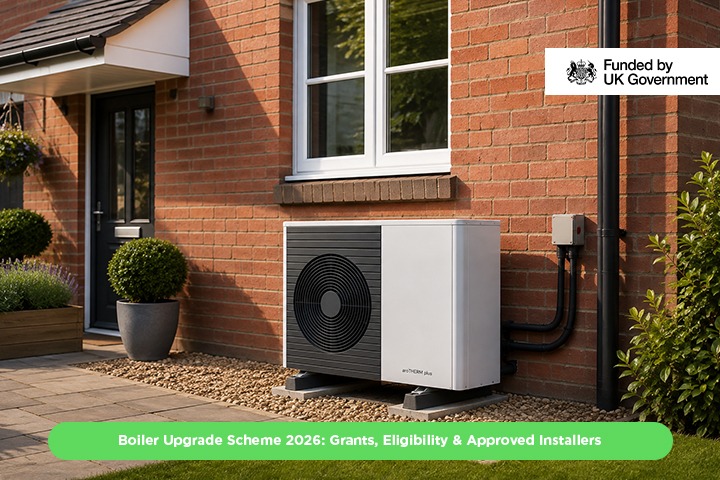
Old gas boiler on its last legs? Before you get quotes for a heat pump, it’s worth getting your head around the Boiler Upgrade Scheme. It’s the government grant — run through Ofgem — that can take £7,500 off the cost, sometimes more. Below, the team at British Energy Services breaks down what it covers, who actually qualifies, and how the money side of things works in practice.
Key Facts About the Boiler Upgrade Scheme
- What it is: a grant that lowers the upfront cost of swapping fossil fuel heating for a heat pump or biomass boiler
- Who’s behind it: Ofgem, on behalf of the Department for Energy Security and Net Zero
- Where it applies: England and Wales only
- What’s on offer: £7,500 for most heat pumps, £2,500 for air-to-air, £5,000 for biomass — and up to £9,000 off-gas-grid, from 21 July 2026
- How it lands: as a discount on your installer’s quote, not a payment to you
- Runs until: 31 March 2027, as things currently stand
- So far: 96,000+ vouchers issued, £635 million+ paid out (July 2026 figures)
What Is the Boiler Upgrade Scheme, Exactly?
It’s not a like-for-like boiler swap grant. That’s the bit people sometimes get wrong going in. The whole point of BUS is steering homeowners toward low-carbon heating specifically — heat pumps mostly, biomass boilers for a narrower slice of properties.
And here’s the part that actually matters for you day to day: it’s installer-led. Your MCS-certified installer does the voucher application, deals with Ofgem, and simply takes the grant off what you’re charged. No forms to fill in on your end. No waiting around for a payment to clear.
So How Much Money Are We Talking About in 2026?
Depends on the tech, and for some households, on whether you’re even connected to mains gas.
| Heating Technology | Grant Amount | Eligible Property Type |
| Air-to-water heat pump | £7,500 | Residential, standard |
| Ground source heat pump | £7,500 | Residential, standard |
| Water source heat pump | £7,500 | Residential, standard |
| Air-to-air heat pump | £2,500 | Residential only |
| Biomass boiler | £5,000 | Rural, off-gas-grid, emissions-compliant |
| Air-to-water/ground source heat pump | £9,000 | Off-gas-grid, replacing oil or LPG heating |
That bottom row is the one to pay attention to. Since 21 July 2026, off-gas-grid properties switching from oil or LPG to an air-to-water or ground source heat pump can get £9,000 instead of the usual £7,500. It won’t last forever, either — the enhanced rate’s currently pencilled in through 31 March 2027, so don’t sit on it too long if it applies to you.
Who Actually Qualifies FOR Boiler Upgrade Scheme?
Broadly: you own a property in England or Wales, and you’re replacing an existing fossil fuel or qualifying electric system. That covers more ground than people assume.
- Homes, second homes, rentals, and business premises are all fair game
- The new system has to genuinely replace what’s already there, not sit alongside it
- Most new builds and social housing miss out, though some self-build properties get an exception
- Already had government funding or ECO support for the same job? That rules you out
- Whatever heat pump goes in needs to be sized right and meet the scheme’s technical bar
Two hard no’s worth knowing upfront: hybrid systems that keep a fossil fuel boiler running alongside a heat pump don’t make the cut, and you can’t use BUS to swap one low-carbon system for another.
Which Heating Systems Does BUS Actually Cover?
Three types of heat pump, plus biomass under stricter rules.
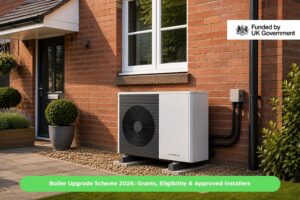
- Air source heat pumps — take heat from the outdoor air, use it for space heating and hot water
- Ground source heat pumps — pull heat from buried ground pipework; you’ll need decent outdoor space for this
- Water source heat pumps — viable where the site allows, though this is the rarest of the three
- Biomass boilers — limited to rural, off-gas-grid properties that meet specific emissions standards
What suits you comes down to the property — land, layout, what’s already installed — rather than chasing whichever option has the biggest number attached to it. If your home has no gas connection, our Air Source Heat Pump Grant page covers what that route looks like in more detail.
Does the Installer Need to Be MCS-Certified?
Yes. Not optional, not a nice-to-have. Only installers with MCS certification for the specific technology can apply for BUS funding on your behalf, and that’s what gives Ofgem some assurance the job’s being done properly and the kit meets standard.
There’s also an Ofgem Product Eligibility List, though don’t read too much into it — being on that list doesn’t guarantee every install using that product automatically clears every BUS requirement. British Energy Services is TrustMark-registered, and our installations are carried out by Gas Safe engineers to PAS 2030 and PAS 2035 standards — before you book anyone, it’s worth asking a few things directly:
- Are you MCS-certified for this exact technology?
- How often do you actually process BUS applications?
- Does what you’re proposing meet the scheme’s technical requirements?
- Will the grant show up as its own line on the quote?
What Does Applying Actually Involve?
Less than you’d think, since you’re not the one doing the applying. Roughly, it goes like this:
- Installer assesses the property, works out what fits
- You get a quote with the grant already knocked off
- You give consent and hand over what’s needed
- Installer submits the voucher to Ofgem
- Ofgem checks it over and processes the voucher
- Work happens, installer claims payment once approved
There are deadlines tucked into this process, so it’s worth having that conversation about timing before anything kicks off — not once you’re halfway through. Our own Boiler Upgrade Scheme page walks through how we handle the survey and application on our customers’ behalf.
BUS Scheme
Ditch your high-burning fossil-fuel or inefficient electric heating system, switch to 400% efficient Air Source Heat Pump with up to £9,000 government grants.
What's Ofgem's Role in All This?
Ofgem runs the scheme for the Gas and Electricity Markets Authority. Their end of it covers:
- Processing voucher applications as they come in
- Handling redemption once a voucher’s issued
- Paying installers once claims get approved
- Monitoring compliance across the scheme
- Keeping guidance current — last updated July 2026
For scale: as of July 2026, over 96,000 vouchers had gone out and more than £635 million paid since launch. That’s a scheme with a proper track record behind it at this point, not something brand new.
Do You Need an EPC First?
For retrofit properties, usually yes — your installer will need an EPC number as part of the application. No valid EPC? There’s alternative evidence that can be used, so it’s not necessarily a blocker.
Insulation isn’t a requirement, but it does help. Heat pumps run at lower temperatures than a gas boiler does, so a well-insulated home tends to get more out of the same system. And having already had energy-efficiency work done won’t disqualify you from BUS either — that’s a common misconception. If your loft or walls haven’t been done, our Free Insulation Grant page is worth a look before you commit to a heat pump quote.
Is It Actually Worth Applying?
For most people replacing an old fossil fuel boiler — yes. £7,500, or £9,000 if the off-gas-grid rate applies, makes a genuine difference to the upfront cost. But the grant’s only part of the picture. Worth weighing up too:
- What you’ll actually be paying once the grant’s deducted
- Running costs once it’s installed and up and running
- How your current heating system is holding up
- How well insulated the property already is
- Your hot water needs
- Whether the property’s genuinely suited to a heat pump
A proper assessment matters here, because a heat pump isn’t always a direct swap for a gas boiler. Radiators, controls, hot water setup — all of it can need rethinking, and that’s easy to underestimate until someone’s actually been round to look. If you’re also weighing up generating your own electricity to go with it, our Solar Panel Installation service covers panels and battery storage from £0 deposit.
The Main Things to Take Away
- BUS covers England and Wales only
- Grants range £2,500 to £9,000 depending on technology and property
- The £9,000 off-gas-grid rate runs 21 July 2026 to 31 March 2027
- Installers apply for and receive the grant — not homeowners
- MCS certification is a hard requirement for installers
- Hybrid systems and low-carbon-to-low-carbon swaps aren’t eligible
- Rules do change, so check Ofgem and GOV.UK before booking anything
Ready to Check Your Eligibility?
British Energy Services is a TrustMark-registered installer working across England and Wales, and we handle the Boiler Upgrade Scheme survey, voucher application, and installation from start to finish — so you’re not left chasing paperwork. If you’re not sure whether your property qualifies, or you’d rather just talk it through with someone first, our team’s happy to help.
Get in touch on +44 7883 315562 or email contact@britishenergyservices.co.uk, or head to our Contact page to start a free eligibility check.
Frequently Asked Questions
Nope — England and Wales only. Scotland and Northern Ireland run their own separate heating grant schemes, so if that’s you, look there instead.
Depends entirely on what’s going in. Standard heat pumps (air-to-water, ground source, water source) are £7,500. Air-to-air comes in lower at £2,500. Biomass boilers get £5,000. And if you’re off the gas grid switching from oil or LPG, you could get up to £9,000 as of 21 July 2026.
No — this catches people out more than you’d expect. There’s no cheque, no bank transfer. Your installer just takes the grant off your bill before you pay it, then sorts things out with Ofgem afterward.
Afraid not. Keep the old boiler running as a backup alongside a new heat pump, and that hybrid setup falls outside what BUS covers.
31 March 2027 is the current cut-off, and that applies to the enhanced £9,000 off-gas-grid rate too.
Mostly no. New builds and social housing are excluded from the scheme, though a small number of self-build properties can still get in under the rules.
They can, yes. Rental properties are included right alongside homes, second homes, and business premises.
The scheme itself doesn’t, no — it’s strictly heat pumps and, in narrower cases, biomass boilers. If you’re after solar as well, that’s a separate route (British Energy Services installs solar PV and battery storage directly, so it’s worth asking about pairing the two).
Different aims, really. BUS funds the heat pump or biomass switch itself, for any eligible owner. ECO4 is broader energy-efficiency support, generally aimed at households on qualifying benefits or with a poor EPC rating, and can cover boilers, insulation, and more. Worth knowing — if a property’s already had ECO funding for a given installation, it can’t also claim BUS for the same one.
Usually, yes, for retrofit properties – your installer will need an EPC number for the application. If there’s no valid one, there are other forms of evidence that can be used instead, so it’s rarely a total dead end.
Yes, second homes are covered too, right alongside main residences, rental properties, and business premises.
Then they can’t apply for BUS funding on your behalf, full stop. MCS certification for the specific technology is non-negotiable, so check this before agreeing to anything.
No — it’s a lot more specific than that. It only kicks in for off-gas-grid properties switching from oil or LPG to an air-to-water or ground source heat pump, and only between 21 July 2026 and 31 March 2027. Everyone else is looking at the standard £7,500.